Vintage means harvest year, not bottling year
A year on a wine label can be mistaken for a bottling date, a purchase date or the start of a countdown. Learn what vintage means, then separate it from other dates that may appear in a producer’s information or an archive record.
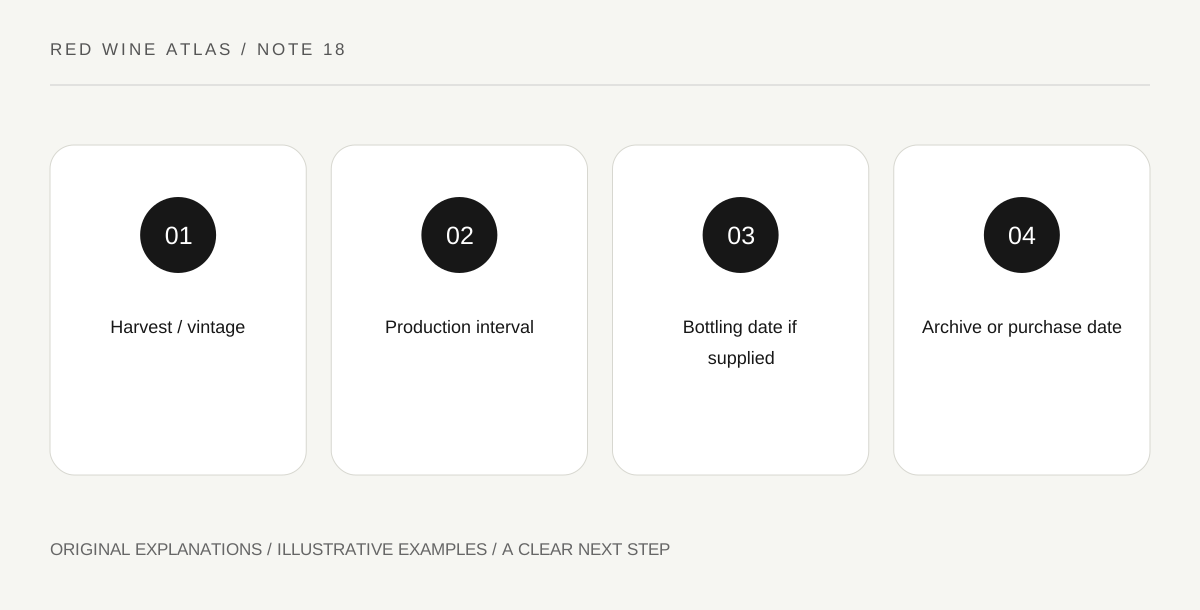
Original explanatory diagram. Read the full method and limitations below.
Place vintage at the harvest point
The TTB guide defines a vintage date in terms of the grape harvest year. That is the central distinction for this exercise. Draw a timeline with harvest, production, bottling and your record date as separate points. Put the vintage at harvest rather than moving it to the bottling point. A label’s year does not automatically disclose how much time passed before bottling or release. Those intervals require other information. The diagram can contain blank dates without being incomplete as a teaching tool; the blanks show which facts the vintage alone does not establish.
Avoid inventing a complete schedule
Suppose a fictional card states vintage 2022 but gives no bottling date. You cannot calculate exact time in barrel or bottle from that year alone. Even subtracting it from the current calendar year does not reveal a complete production history. Write the missing intervals as questions. This prevents a neat-looking numerical exercise from creating facts that were never supplied. The arithmetic may be correct while the interpretation is wrong. A better worksheet asks which dates are known and what each one represents before asking for any duration. Duration is meaningful only when both endpoints have appropriate definitions.
Non-vintage does not mean no history
When no vintage is declared, do not conclude that the grapes had no harvest years or that the wine was made immediately before sale. The label simply does not make the same vintage statement. A product may have other identifying information, but those fields should not be relabelled vintage without support. The literacy lesson is about declared information. Distinguish absence of a claim from proof of its opposite. A blank vintage field and a fictional recent bottling date can coexist without giving you the exact harvest composition or a reason to infer quality.
Match any precise rule to its system
Different labelling systems can specify conditions for using vintage wording. This guide does not supply a universal percentage rule or a legal approval judgment. If exact requirements matter, consult the relevant current official source for that product and jurisdiction. For ordinary study, keep the conceptual meaning separate from the detailed eligibility condition. A page can teach harvest-year meaning without pretending that the same condition applies everywhere. In your notes, give the definition one line and any verified jurisdiction-specific requirement another. That structure makes later updates easier and reduces the chance that a local rule becomes a worldwide assumption.
Label the endpoints before doing subtraction, even in a simple classroom example.
Illustrative document exercise
A fictional archive entry states harvest year 2021, bottling date 2023 and catalogue date 2025. Place three distinct marks on a timeline. The vintage corresponds to 2021. Do not call the wine a 2023 vintage because it was bottled then, and do not infer exact vessel time from the gap unless the production record specifies how that interval was used.
Practical checks
Optional checkboxes save only in this browser.
Questions that come up
Is vintage the year a bottle was purchased?
No. In the label meaning discussed here, it refers to harvest-year information. Purchase date is a separate event.
Does no vintage statement imply poor quality?
That conclusion does not follow. The absence of a declared vintage answers an information question, not a universal quality question.
References and scope
These sources support the factual background. Examples and exercises are original illustrative teaching material. References do not imply endorsement.
- US TTB: label anatomy — US wine-label fields and vintage as harvest-year information, within the guide’s jurisdiction.