Cabernet Sauvignon: what does structured describe?
Cabernet Sauvignon often arrives with words such as firm, structured and dark-fruited. Those words describe different aspects of a wine. Understanding their jobs lets you read more precisely without assuming that every Cabernet Sauvignon has the same texture or needs years in a cellar.
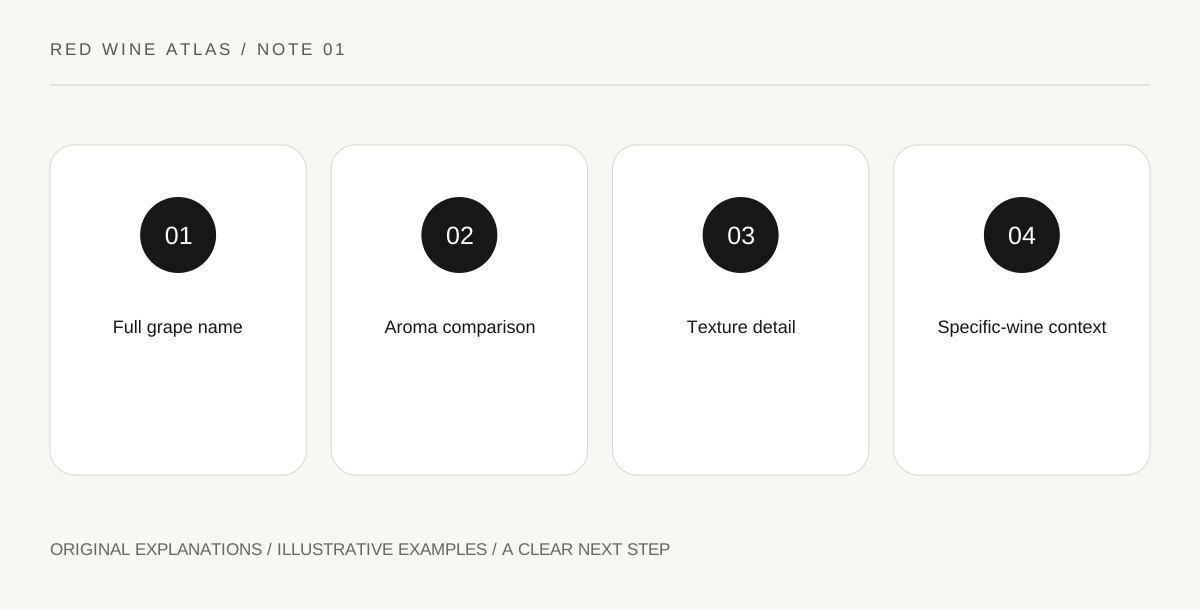
Original explanatory diagram. Read the full method and limitations below.
Begin with the complete grape name
Cabernet Sauvignon is a red grape variety. Keep both words when recording it: Cabernet alone leaves room for confusion with Cabernet Franc. Bordeaux’s guide describes firm tannins and black-fruit associations. Treat these as orientation rather than a compulsory checklist. A named grape identifies plant material used for wine; it does not specify every vineyard condition, production decision or finished aroma. On a fictional information card, place Cabernet Sauvignon in the grape box and leave separate boxes for origin, harvest year and producer. A clearly named field is easier to compare than a string of impressions.
Unpack a texture sentence
In ordinary wine writing, structured usually points toward how a wine’s components feel and relate. It is less specific than an actual description of those components. Rewrite powerfully structured into questions: does the writer mean drying tannin, noticeable acidity, substantial weight, or some combination? This does not require agreement with the writer. The exercise teaches you to ask for observable detail. A description saying firm tannin with fresh acidity supplies more information than a dramatic adjective alone, even when both concern the same grape. Keep the writer’s evaluative reaction separate from the details used to support it.
Underline the actual component named before writing a short paraphrase in your own words.
Keep aroma apart from ingredients
Blackcurrant or cassis language is an aromatic comparison, not an assertion that fruit syrup was added. Copy such terms into an aroma column rather than an ingredient list. Also distinguish intensity from identity: strong aroma says how much, while blackcurrant aroma suggests what it resembles. An educational note can preserve both without pretending to identify the exact chemical cause. If another description uses mint or spice, do not add those words automatically. A shorter set of clearly attributed observations is more informative than an accumulated list of every association ever attached to the grape.
Read age-related claims carefully
The Bordeaux guide links Cabernet Sauvignon’s tannins with ageing potential, but potential is not a date printed by nature on every bottle. Suitable for ageing and must be aged are different claims. Highlight whether a drinking-window statement belongs to a specific producer, wine and vintage or to a general grape overview. Do not convert a broad overview into a storage guarantee. A useful note might say the description emphasizes tannin but gives no specific ageing recommendation. That sentence records what you actually learned and what remains unresolved, instead of turning a general reputation into an instruction.
Illustrative reading exercise
A fictional card reads Cabernet Sauvignon, Valley A, 2023; blackcurrant aroma, firm tannin. Mark grape, origin, harvest-year information, aroma comparison and texture separately. Nothing establishes added blackcurrant or a requirement to store the wine for ten years. Rewrite the description as five fields so another reader can see exactly which question each phrase answers.
Practical checks
Optional checkboxes save only in this browser.
Questions that come up
Is it the same as Cabernet Franc?
No. They are separate varieties. Similar names and shared appearances in blends do not make them interchangeable; use the complete name when comparing information.
Does dark-fruit language mean sweetness?
It does not establish sweetness. Fruit aroma, texture and sugar-related sweetness are separate descriptive questions, even when casual writing combines them in one sentence.
References and scope
These sources support the factual background. Examples and exercises are original illustrative teaching material. References do not imply endorsement.
- Bordeaux: Cabernet Sauvignon — Cabernet Sauvignon identity and broad Bordeaux texture/aroma vocabulary.