Pinot Noir and the colour of its juice
Pinot Noir is associated with red wine, yet the colour of the finished wine is also a question of production. The Bourgogne wine board’s explanation of clear juice and coloured skins offers a practical way to separate grape identity from wine colour.
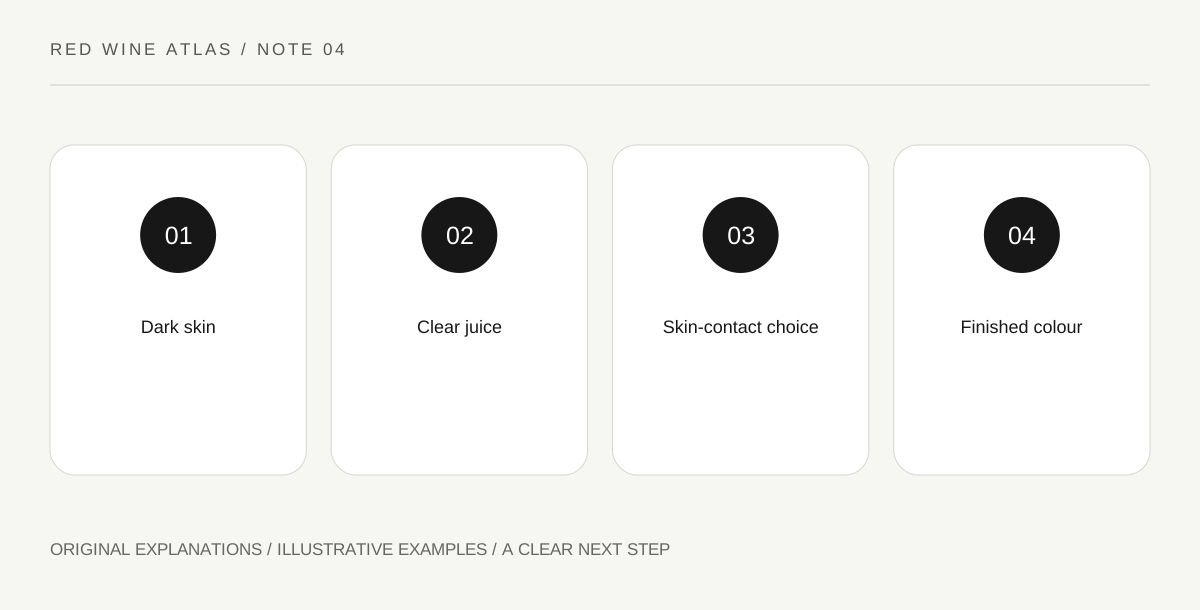
Original explanatory diagram. Read the full method and limitations below.
Put grape and colour in different boxes
Pinot Noir is a grape variety; red wine describes a category of finished wine. The Bourgogne board explains that its juice is clear and that contact with skins contributes red colour. This corrects a mental picture of red grapes yielding already-red juice. Draw a berry in cross-section and label skin and interior separately. Then draw another box for the wine. The diagram reminds you that the result depends on what happens between fruit and container, not solely on the name attached to the vine. Keep the drawing explanatory rather than attempting a production recipe.
Understand what colour can establish
A red colour description does not by itself identify Pinot Noir. Many wines can be red, and the same grape can contribute to different finished categories. Read the grape declaration rather than reverse-identifying a variety from a photograph. Lighting, screen settings and glass backgrounds make online colour comparison especially weak as an identification exercise. A photograph illustrates appearance; it cannot replace a composition statement. On a worksheet, write colour shown: red separately from grape stated: Pinot Noir. This simple distinction prevents an inference the image cannot support and lets you note when a grape has not been stated at all.
Keep regional shorthand in context
Bourgogne is a place-linked wine name, while Pinot Noir names a grape. Their association is useful, but the words are not synonyms. The regional board also discusses white varieties and other grapes, so a regional name alone should not be translated into one grape without reading the wine category. Underline the geographical expression and circle the grape statement when present. If a label leaves the grape implicit, consult the specific appellation information instead of filling the blank from a regional slogan. A familiar place name is a starting point for reading, not the end of the identification task.
Use the white-wine counterexample
The board gives Blanc de Noirs Crémant as an example of white wine from dark grapes. You do not need a recipe to learn the lesson. Its value is logical: a dark grape name does not force a red finished colour. Make three columns for grape identity, wine colour and still-or-sparkling description. These let you compare a still red Pinot Noir with a white sparkling example without treating one as a contradiction. Each row needs its own evidence. Neither supplies universal instructions for every producer, and sparkling should not be treated as another word for white.
Illustrative reading exercise
A fictional archive card says Pinot Noir; white sparkling wine. A learner initially flags an error because Noir means black. Revise the analysis: the variety is dark-skinned, while the finished colour can be white when the relevant production avoids extracting red skin colour. Keep sparkling as a separate property. The corrected card now separates three questions that the first reading had merged.
Practical checks
Optional checkboxes save only in this browser.
Questions that come up
Is all Pinot Noir red wine?
No. The Bourgogne board explains white wine from Pinot Noir in its Blanc de Noirs example. Grape identity and finished colour are separate information.
Does Bourgogne always mean Pinot Noir?
No. The region also produces wines from white and other varieties. Read the particular wine name and category before interpreting an implied grape.
References and scope
These sources support the factual background. Examples and exercises are original illustrative teaching material. References do not imply endorsement.
- Bourgogne: varieties and colour — Pinot Noir, clear juice, coloured skins and Blanc de Noirs in Bourgogne.