Merlot beyond the word soft
Calling Merlot soft can be a useful first impression, but it becomes misleading when used as a complete definition. Merlot appears in varied wines and blends. Read its descriptions by separating texture, fruit language and the particular wine being discussed.
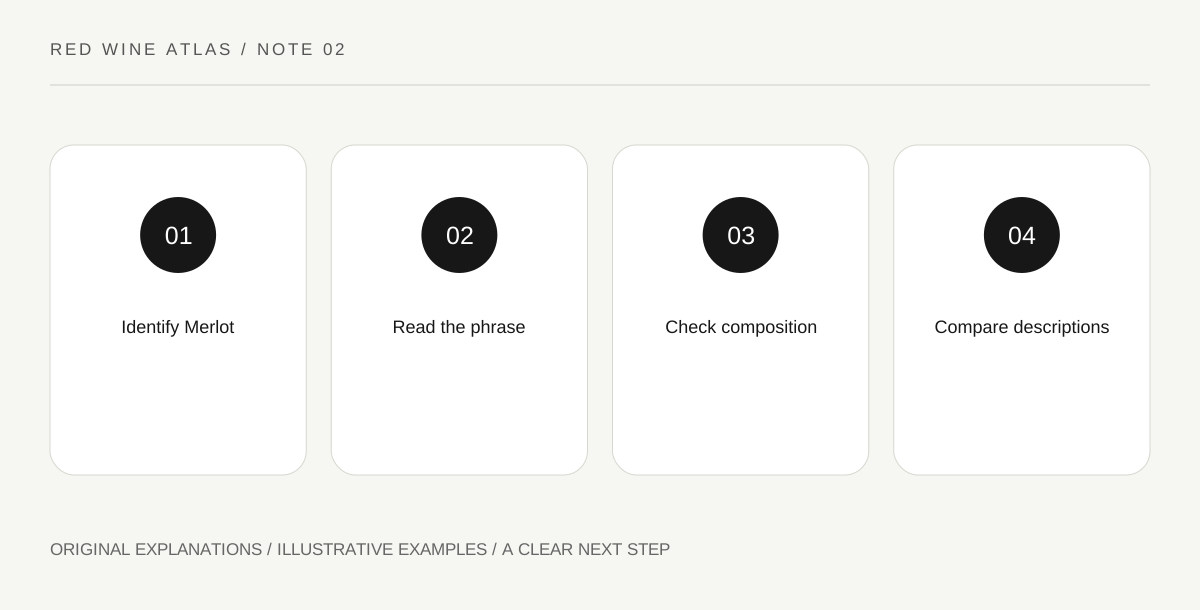
Original explanatory diagram. Read the full method and limitations below.
A variety with several expressions
Bordeaux’s Merlot guide describes a range from lighter styles to dense wines. That range is the central lesson: a grape name is not one fixed finished product. Rather than making a ladder from simple Merlot to serious Cabernet, draw two independent axes on paper, one for descriptive weight and one for tannin language. Place hypothetical descriptions on that map. This removes the assumption that gentler texture signals lower quality, or that a powerful wine must come from a different grape. The map represents descriptive language, not a laboratory measurement or a ranking.
Leave room between entries for later information, so a first impression does not become an irreversible category.
Translate soft into clearer detail
Soft might suggest rounded texture, less prominent tannin, or simply a writer’s favourable reaction. Ask what other words accompany it. Supple and light-bodied could describe something different from supple and concentrated. Preserve the whole phrase rather than extracting only the grape and one adjective. In your notes, record a short term and then explain the question it answers. For example, supple is a texture claim, not enough information to establish sweetness. This editing exercise remains useful without opening a bottle: its purpose is to make the information in a written description more explicit.
Understand a role within a blend
Merlot can be a component in a red Bordeaux blend. A producer’s blend statement supplies composition information, but a general variety profile cannot reveal percentages in an individual wine. Do not infer a recipe from regional reputation. Compare two fictional technical sheets: one states 70% Merlot, another gives no percentages. The first supports a numerical composition statement; the second supports only what is printed. Calling both Merlot-dominated would require evidence for both, however plausible the guess. Keep a blank where evidence is absent and preserve any qualifying words such as predominantly or includes.
Build a better comparison question
Instead of asking whether Merlot is always soft, ask how two specified Merlot descriptions differ. Keep the comparison small: origin wording, vintage, stated composition and two sensory claims are enough. If one sheet mentions plum and another cherry, that does not prove a universal regional law. It gives you two examples of descriptive language. Distinguish the producer’s claim from your interpretation: Sheet A emphasizes rounded texture; Sheet B emphasizes intensity. The result is more useful than declaring one a more authentic example. It also leaves room to revise the comparison when more specific information becomes available.
Illustrative reading exercise
Imagine two catalogue entries: Merlot, light body, cherry notes; and Merlot-led blend, dense texture, plum notes. Create separate rows. Leave the second row’s exact percentage blank unless supplied. Merlot, Merlot-led and light answer different questions; none should be silently substituted for another. You can compare these descriptions without ranking the wines or inventing their complete compositions.
Practical checks
Optional checkboxes save only in this browser.
Questions that come up
Is Merlot only a blending grape?
No. Appearing in blends does not prevent it from being presented as a varietal wine. Read the composition statement for the particular example.
Does Merlot automatically mean light wine?
No. The regional guide describes varied styles. A general grape association cannot replace information about the specific wine’s production and description.
References and scope
These sources support the factual background. Examples and exercises are original illustrative teaching material. References do not imply endorsement.
- Bordeaux: Merlot — Merlot identity and the range of styles discussed by Bordeaux’s wine body.