Oak is a maturation question, not a grape variety
Wine descriptions may place oak words beside grape names and aroma comparisons. Those statements operate at different levels. Learn to distinguish a documented maturation choice from a sensory association and avoid treating a barrel-related phrase as a complete definition of a red wine.
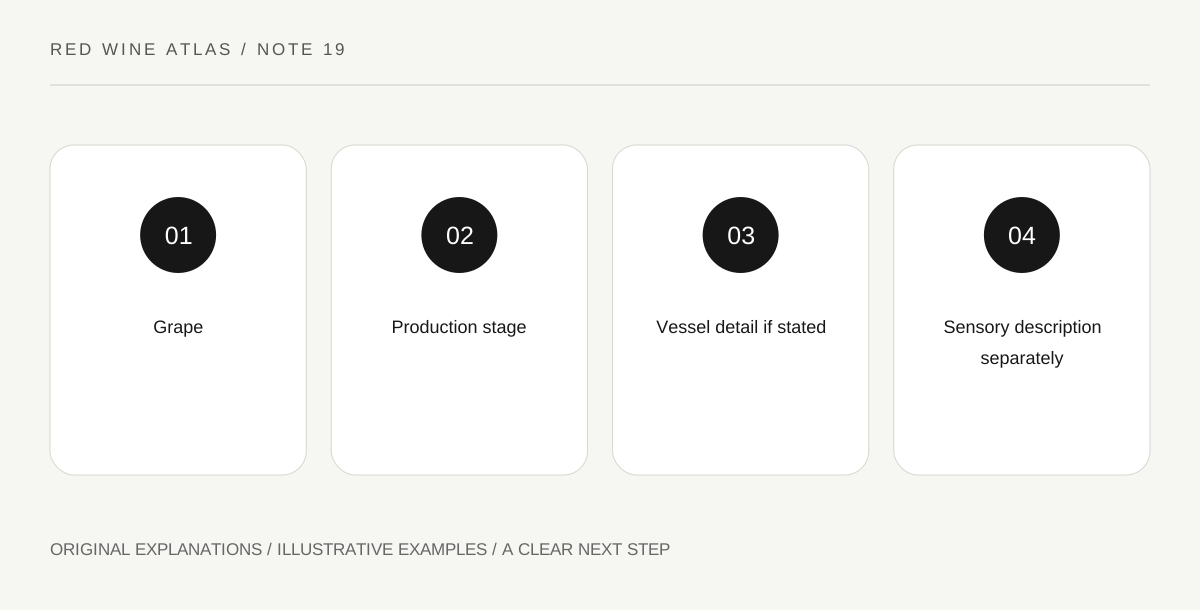
Original explanatory diagram. Read the full method and limitations below.
Separate material from plant identity
Oak refers to a material used in some production and maturation contexts; Cabernet Sauvignon or Shiraz identifies a grape variety. Place the words in separate fields. Wine Australia’s Shiraz overview discusses several maturation approaches, while Bordeaux’s blending explanation describes varied vessel choices. These examples show why a grape name does not automatically disclose one vessel. A wine can be identified by grape while its production record remains unspecified. In a diagram, draw the grape feeding into a production box with several possible routes rather than directly into a single mandatory barrel. The illustration should express a distinction, not prescribe a cellar procedure.
Read the actual vessel statement
Matured in oak, fermented in a specified vessel and described as oaky are not interchangeable sentences. One can concern a documented production stage, another a sensory impression. Copy the statement before interpreting it, and identify which stage it explicitly names. If it says only matured, do not add a fermentation vessel. If it gives no duration, do not invent one. Precision about the scope of the statement is more useful than collecting familiar barrel vocabulary. A short phrase may answer one production question while leaving several others open, which your worksheet should show.
Do not reverse-engineer a barrel from one aroma
Vanilla, spice or toast-like wording may prompt a reader to wonder about maturation, but a sensory comparison alone does not establish a full barrel history. Record the comparison in an aroma field and seek an actual production statement if that history matters. This avoids a circular exercise in which a learner assumes oak, predicts an aroma, then treats the aroma as proof of the assumption. A document comparison can demonstrate the logic without any tasting. Label one card sensory language only and another production detail supplied, then identify how much each can establish independently.
Use a matrix rather than a ladder
A barrel choice should not automatically become a quality ranking. For study, make rows for grape and columns for documented maturation wording. Place fictional examples into the cells without arranging them from inferior to superior. The matrix shows combinations and missing information. It can accommodate a wine with a clear grape statement but no vessel detail, as well as a wine with extensive production notes. More information is not the same as a promise of greater personal enjoyment. The exercise keeps material, process, description and evaluation separate enough that a reader can inspect each claim on its own terms.
A vessel field can remain empty without weakening the correctly identified grape field.
Illustrative document exercise
A fictional sheet says Shiraz; matured in older oak barrels. Another says Syrah; spice-like aroma, maturation unspecified. Both identify the shared grape, but only the first supplies that vessel statement. Keep the second’s spice comparison in its aroma field. Do not fill its maturation field by copying the first or by treating spice as proof.
Practical checks
Optional checkboxes save only in this browser.
Questions that come up
Does a grape name require oak maturation?
No. The cited regional explanations discuss varied approaches. Read the particular wine’s production information.
Does an oak-like description reveal a complete process?
No. It is a description, not an entire production record. Vessel, stage and duration require their own stated evidence.
References and scope
These sources support the factual background. Examples and exercises are original illustrative teaching material. References do not imply endorsement.
- Wine Australia: Shiraz — Shiraz/Syrah naming, varied styles, GSM and varied maturation approaches.
- Bordeaux: blending — Red Bordeaux components, blending choices and varied maturation vessels.