Tempranillo is not another word for Rioja
Rioja is closely associated with Tempranillo, yet its official red-grape guide lists several varieties. This makes the region a useful place to practise reading dominant associations without converting them into absolute definitions, exact blend percentages or universal flavour promises.
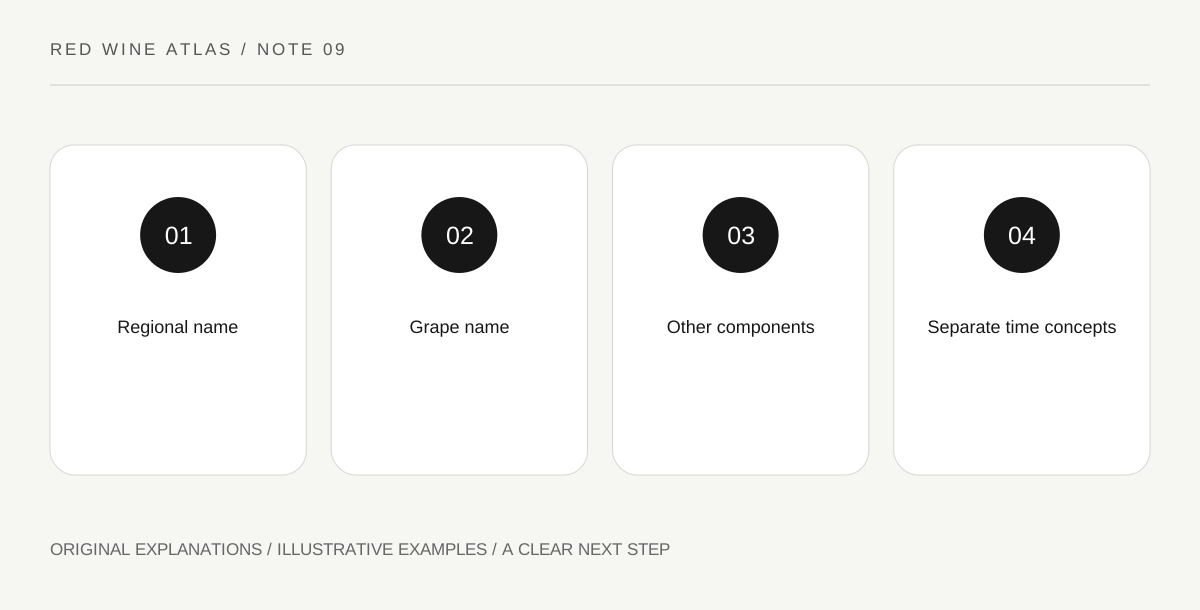
Original explanatory diagram. Read the full method and limitations below.
A region and a leading grape
Tempranillo names a grape variety. Rioja is a regional designation, not another name for that grape. The Control Board discusses Tempranillo alongside other red varieties. Preserve both naming levels: write Rioja on a regional-context card and Tempranillo on a grape-identity card. Connect them with a line labelled associated rather than an equals sign. This small graphical distinction leaves room for the regional system to contain multiple grapes and expressions. It also helps with conversation: someone asking what Rioja is may need a geographical explanation, whereas someone asking what Tempranillo is needs a grape explanation. Answering one does not automatically answer the other.
Early ripening is a vineyard concept
The official guide connects Tempranillo’s name with comparatively early ripening. This does not promise when a finished wine is ready to be consumed. Ripening, harvest, cellar maturation and bottle age belong to different points in a timeline. Put vine development before harvest and production after it. Do not add a recommended drinking date unless a specific statement supplies one. A linguistic clue can explain a grape name without functioning as a storage instruction. For a classroom exercise, attach each word to the stage it describes, then ask which stages remain unspecified by a label showing only grape, region and year.
Make room for the other grapes
A sheet listing Tempranillo and Graciano is not inconsistent with Rioja simply because an introductory lesson emphasized Tempranillo alone. Read the list as information about that wine. Give every stated component its own row and add percentages only when supplied. A variety list and a complete blend statement are different forms of information. Drawing an unscaled set of components is more accurate than inventing a proportional diagram. Keep unfamiliar names visible instead of dropping them to simplify your notes. They may be precisely what distinguishes the wine’s stated composition from the broad regional association you already knew.
Separate composition from maturation wording
A regional maturation category does not name a grape. Two descriptions can both mention Tempranillo while supplying different category or production information. Read through several fields rather than stopping at the first familiar word. A useful annotation says grape explicitly named, regional designation supplied, exact composition not supplied here. That is a completed reading result, not a failure to learn everything. If another document later supplies percentages or cellar details, add them with their source. Do not retrofit them into your transcription of the original label, because that would hide the distinction between what the label said and what you subsequently discovered.
A naming association can guide a search without settling its result.
Illustrative study exercise
A fictional description reads Rioja red blend, Tempranillo and Graciano. A learner rewrites it as 100% Tempranillo because that was the grape associated with Rioja in class. Correct the entry by restoring both names and leaving their shares unspecified. The correction preserves a useful regional association without allowing it to overwrite explicit information.
Practical checks
Optional checkboxes save only in this browser.
Questions that come up
Is all red Rioja pure Tempranillo?
Do not assume that. The regional overview discusses several red grapes; a particular wine’s composition needs its own information.
Does early ripening mean early consumption?
No. Fruit development and a finished wine’s ageing suitability are different questions. The name alone provides no drinking-window instruction.
References and scope
These sources support the factual background. Examples and exercises are original illustrative teaching material. References do not imply endorsement.
- Rioja: red varieties — Tempranillo, Garnacha tinta and multiple red varieties within Rioja.