Nebbiolo: why a precise place name matters
Nebbiolo descriptions often emphasize place and structure. A useful introduction keeps the grape visible while asking how specific the origin statement actually is. This avoids treating an entire region as one uniform site or turning a general ageing reputation into a countdown.
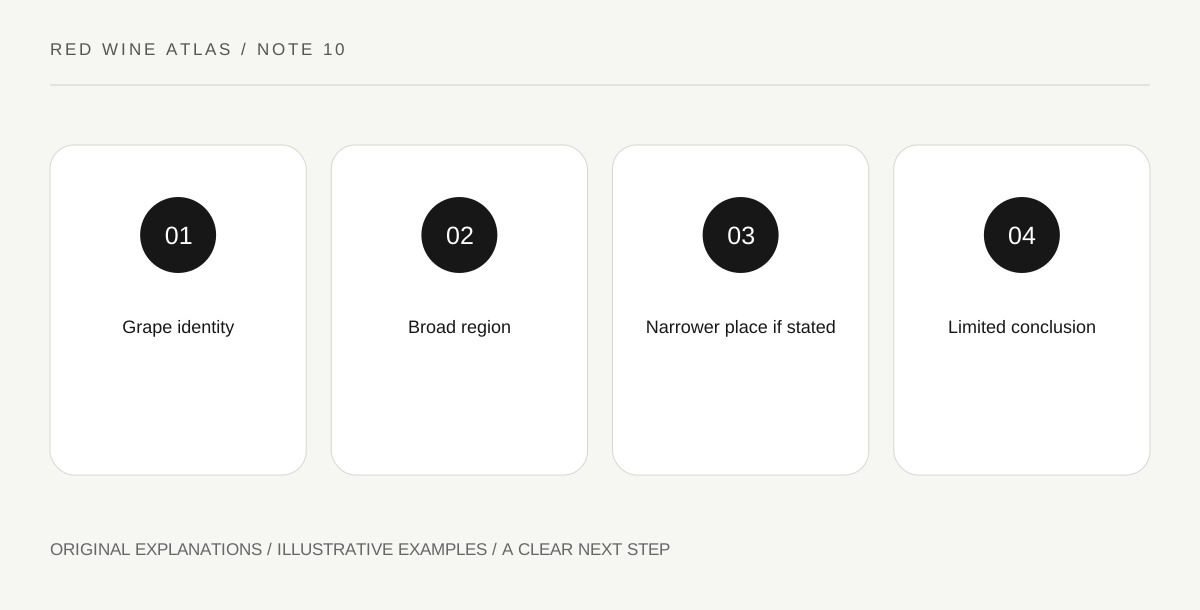
Original explanatory diagram. Read the full method and limitations below.
Start with the grape, then locate the wine
The Langhe consortium identifies Nebbiolo as a traditional dark grape of Piedmont. Put that identity at the centre of a notebook page, then attach separate cards for the specific wine names you encounter. A grape name, a broad region and a narrowly named site occupy different levels of information. They can be related without being interchangeable. Imagine zooming a map: each closer view reveals detail while remaining connected to the wider area. A label may stop at one level, while a producer sheet supplies another. Preserve their exact wording so you can see how much geographical detail is actually available.
Read sensitivity without inventing a cause
The consortium emphasizes Nebbiolo’s responsiveness to growing conditions. This is a reason to expect variation, not permission to attribute every difference to one soil description. If two profiles differ, identify variables that were not held constant. Producer, vintage and production choices may differ alongside location. Write a possible influence as a question rather than a proven explanation when the evidence does not isolate it. This distinction is valuable in written study: a map can show that sites differ, but it cannot alone establish why two wines are described differently. A persuasive story and a demonstrated causal comparison are different achievements.
Treat ageing potential as conditional
Broad discussion of tannin and ageing does not determine a date for every Nebbiolo wine. Keep a distinction between a general grape profile and a recommendation about a named producer, wine and vintage. A paper worksheet can include an empty date field beside a broad potential statement. Leaving it empty is more accurate than inventing ten or twenty years. Also distinguish production maturation already completed from time someone proposes keeping a bottle later. These are separate intervals. A description of one interval does not automatically establish the other, even when both are discussed under the loose heading of age.
Ask a question the documents can answer
A focused comparison might ask how two official descriptions state origin and identify the grape. A label can answer that better than it can answer which wine someone will prefer. Record exact names, stated vintage and any supplied production details. Then write a conclusion limited to those fields. For example, one document supplies a narrower origin than the other. That establishes a difference in specificity, not an automatic quality ranking. A more precise geographical claim can be interesting without becoming a guarantee of a particular aroma, texture or personal response. Learning the distinction makes regional vocabulary easier to use responsibly.
Illustrative study exercise
Create fictional cards saying Nebbiolo, Region A, 2022 and Nebbiolo, Site B within Region A, 2022. The second gives more specific origin information. Both share grape and year, but producer decisions remain uncontrolled. Conclude that the origin wording differs in precision; do not claim that the narrower name proves a particular sensory result.
Practical checks
Optional checkboxes save only in this browser.
Questions that come up
Does Nebbiolo identify one exact place?
No. It identifies a grape. A specific wine’s origin and denomination require additional wording and context.
Can a map explain every sensory difference?
No. Location supplies context, but a comparison also needs to consider other varying conditions. Do not turn a map into proof of a single cause.
References and scope
These sources support the factual background. Examples and exercises are original illustrative teaching material. References do not imply endorsement.
- Langhe: Nebbiolo — Nebbiolo identity and sensitivity to growing conditions.