Barbera: read every syllable
Barbera is a grape name that can be confused with other Italian wine words beginning with similar sounds. Slow reading is more useful than guessing from the opening syllable. Build a small index that separates the grape from complete wine and place names.
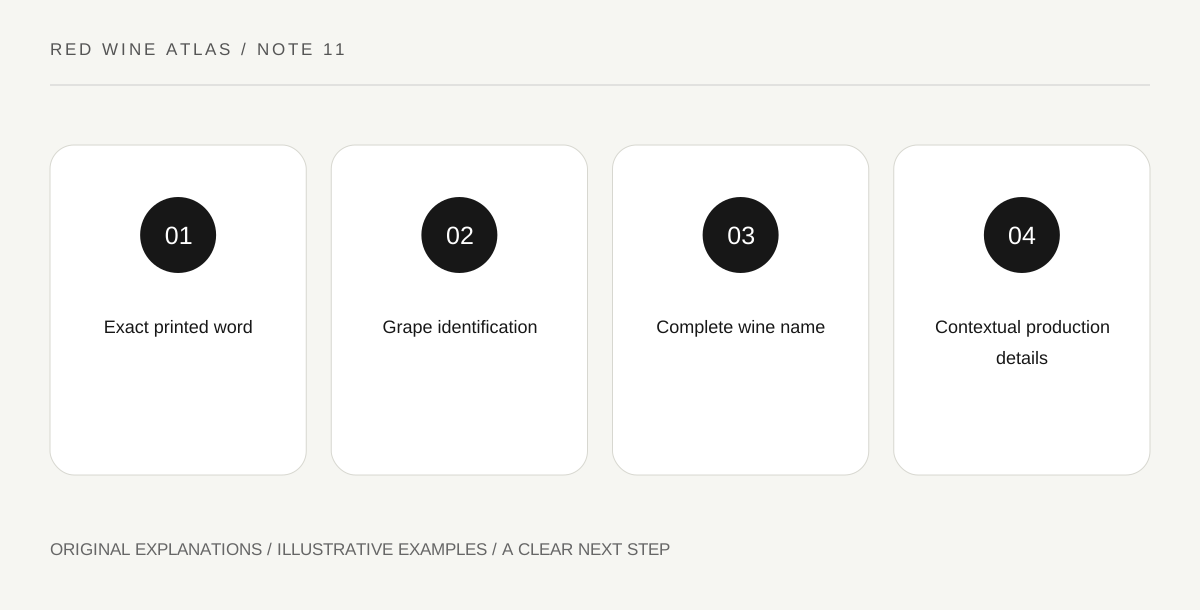
Original explanatory diagram. Read the full method and limitations below.
Make Barbera its own entry
The Langhe consortium presents Barbera as a distinct dark grape associated with Piedmont. Begin with that identity rather than a list of sound-alike words. Write Barbera clearly and compare its ending with any unfamiliar name on another document. Similar spelling does not prove identical meaning. In a digital glossary, store the complete label phrase as well as the recognized grape field. This prevents an automatic search suggestion or a remembered first syllable from replacing the actual word. If a name is unfamiliar, leave it unclassified until its own official context is available.
Read the whole wine name
An expanded wine name may combine a grape with a geographical expression. Treat that whole phrase as meaningful rather than shortening it to the most familiar word. On a worksheet, use one line for the exact printed name and another for your explanation of its parts. This gives you room to learn without corrupting the transcription. A later correction can change the explanation while leaving the original wording intact. It also helps when comparing a front label with a technical sheet: two different-looking phrases may operate at different levels, and neither should be silently edited to look like the other.
Allow more than one production expression
The consortium’s overview discusses Barbera in both younger and age-oriented wine contexts. That is enough to reject a rigid rule that the grape can appear in only one style. When reading two examples, look for the production details actually stated rather than sorting them by a remembered stereotype. A note emphasizing freshness and another emphasizing maturation may be compatible with the same grape identity. You can record this variation without ranking one expression as the authentic one. The grape is a common reference point, while the particular wine remains the correct unit for specific production and sensory claims.
Use an error-correction exercise
Take a fictional index containing three mistakes: Barbera recorded as a region, an unfamiliar similar word replaced with Barbera, and a producer’s maturation statement copied into the grape definition. Repair each differently. Move the first to the grape field; restore the original wording in the second; relocate the third to that producer’s wine record. This is more educational than merely spelling the word correctly because it teaches three forms of classification. A good glossary can hold identity, exact quotations and contextual facts without merging them. Once repaired, test it by asking what information applies to every entry and what applies only to one example.
Search tools are aids to retrieval, not authorities for changing an unfamiliar word.
Illustrative study exercise
A fictional archive row says Barbera, Area C, 2023, maturation statement supplied. Split it into exact name, grape, origin, year and production note. Now imagine a second row with an unfamiliar similar-sounding name. Do not copy Barbera into its grape field. Mark it for its own identification rather than solving the uncertainty through resemblance.
Practical checks
Optional checkboxes save only in this browser.
Questions that come up
Are similar Italian wine names interchangeable?
No. Similar beginnings do not establish shared meaning. Identify each full name using the relevant official source.
Must all Barbera share one style?
No. The consortium describes a range of expressions. Read the particular wine’s information before assigning a fixed style.
References and scope
These sources support the factual background. Examples and exercises are original illustrative teaching material. References do not imply endorsement.
- Langhe: Barbera — Barbera as a distinct Piedmont variety with varied wine expressions.