Malbec: a country is larger than one growing site
Malbec is strongly associated with Argentina, but a national identity is not a single vineyard description. The Argentine wine body’s guide discusses regional variation. Use Malbec to learn how broad origin statements differ from precise site claims and from actual sensory observations.
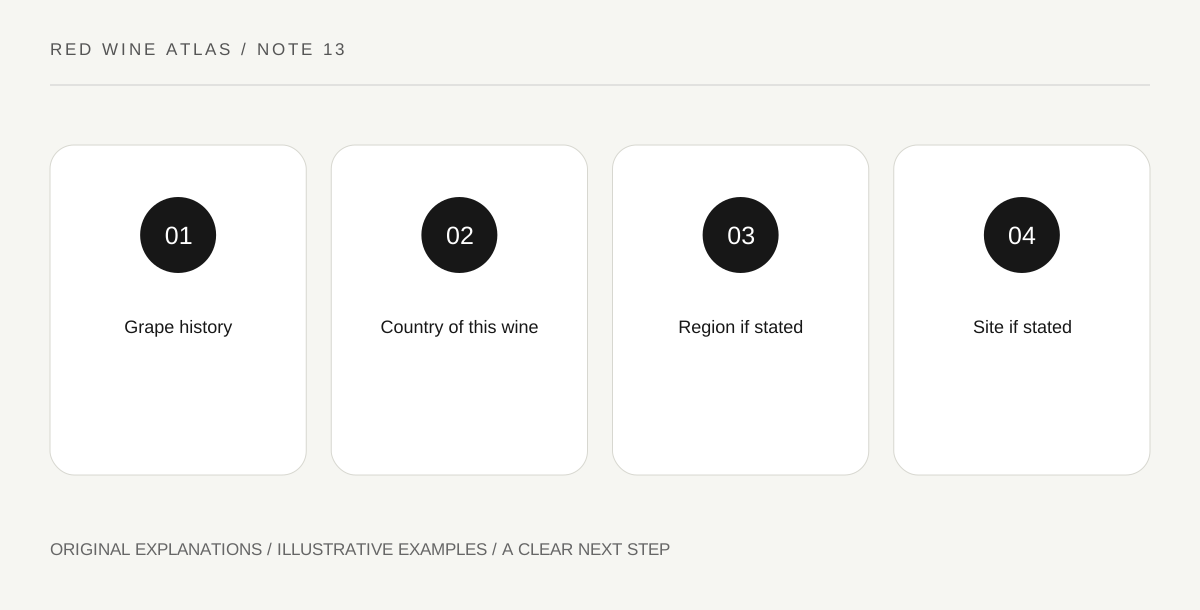
Original explanatory diagram. Read the full method and limitations below.
A grape with a national association
Wines of Argentina presents Malbec as a leading national variety while identifying its French origin. These statements concern different kinds of history and association; they do not compete to be the only true description. A grape can have an origin story and later become strongly identified with another country’s wine culture. Draw two separate lines on a study page, one for historical origin and one for the context of the wine being discussed. This prevents nationality from becoming an essential property attached to every occurrence of the grape name. A particular Malbec still needs its own origin statement.
Zoom from country to region
A national name covers more territory than a named region, which in turn can cover more than one site. The Argentine guide discusses Malbec across regional contexts, reinforcing that the country should not be treated as one uniform vineyard. For a paper exercise, draw nested shapes labelled country, region and site. Add only relationships explicitly supplied by your documents. A place name that sounds precise may still cover an extensive area, so avoid estimating climatic uniformity from the length of its name. The diagram teaches scale without claiming that a smaller geographical designation must produce a better wine.
Compare descriptions without proving a cause
Imagine two Malbec profiles, one emphasizing fresh fruit and one emphasizing a more developed fruit association. They may differ in region, harvest year, producer and maturation. Even if the documents include elevation, that does not isolate elevation as the only cause of the language difference. Create a variable ledger: same grape, other conditions not controlled. This is a more informative conclusion than assigning one aromatic outcome to an entire landscape. Regional education can describe tendencies while a casual two-profile comparison remains an illustration rather than an experiment. Keep those two uses of evidence distinct in your own explanation.
Record whose description you are reading
A producer description, a regional overview and a personal observation have different scopes. Put the speaker beside each sensory phrase. If you are studying only documents, do not rewrite a promotional description as something you personally detected. An archive note can say the guide associates this example with a named fruit family, without claiming a firsthand result. When several sources disagree, preserve their context before trying to reconcile them. The disagreement may involve different wines or different descriptive purposes. A precise record gives future learning somewhere to attach, while an unqualified statement about all Malbec tends to conceal those useful differences.
A blank site field honestly records the document’s limited geographical detail.
Illustrative study exercise
Two fictional cards both state Malbec, Argentina. One adds Region A and Site 1; the other gives no narrower origin. Record the extra specificity on the first card and leave the second broad. Do not invent a site for it or conclude that the first must taste better. The difference established is the precision of the available origin claim.
Practical checks
Optional checkboxes save only in this browser.
Questions that come up
Does Argentine Malbec have one fixed flavour?
A national association does not establish a uniform finished profile. The guide itself discusses diversity among regional expressions.
Does a narrower origin automatically mean higher quality?
No such conclusion follows from specificity alone. A geographical statement and an evaluative judgment answer different questions.
References and scope
These sources support the factual background. Examples and exercises are original illustrative teaching material. References do not imply endorsement.
- Wines of Argentina: varieties — Malbec’s national association and regional variation; Argentine Bonarda in varietal and blend contexts.