GSM does not mean three equal shares
GSM is a convenient abbreviation for a familiar three-grape blend, but the letters do not contain a percentage formula. Use the abbreviation to recognize the components, then look for the actual composition and the naming conventions used by the source.
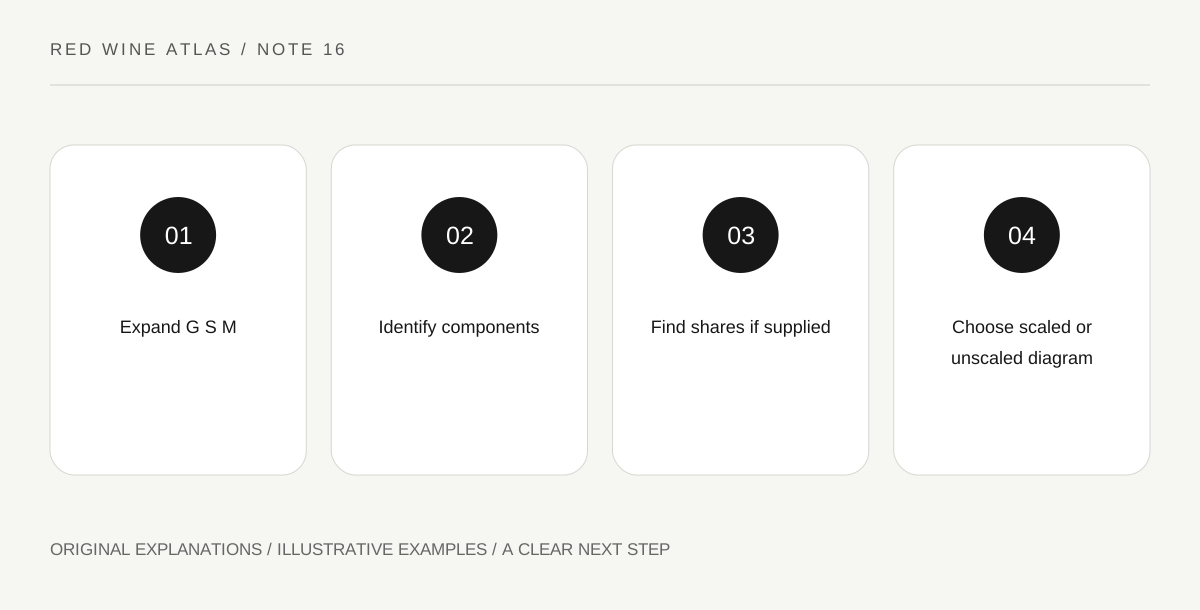
Original explanatory diagram. Read the full method and limitations below.
Expand every letter
In the context described by Wine Australia, GSM refers to Grenache, Shiraz and Mourvèdre. Expand the abbreviation in your notes before doing anything quantitative. This turns three letters into identifiable grape names without assuming that all examples share an origin or precise style. Keep any alternative spelling supplied by the producer alongside the normalized entry. An abbreviation is a useful index, but it hides information when treated as a complete explanation. A reader should be able to move from the shorthand back to the full names and then to the particular wine being described.
Letters are not quantities
Nothing in three letters alone establishes equal thirds. A fictional GSM could be described as 60%, 25% and 15% of the named grapes; another fictional example could use different shares. The point is not to propose real recipes but to show the logical space left open by an abbreviation. If a document provides no figures, use three unscaled labels rather than a balanced three-sector pie. Equal-looking graphics can invent equality even when the prose does not. Accuracy therefore depends on visual choices as well as sentences, especially when an educational site turns a component list into an illustration.
Read order cautiously
A shortened name can be a conventional label rather than a complete legal composition declaration. Do not decide that the first letter proves the largest share in every document and jurisdiction. If the source supplies actual percentages, use those. If it supplies only component names, state that limitation. For a paper exercise, place a component list beside two hypothetical percentage sets and ask whether the list alone selects between them. It cannot. The exercise demonstrates why a familiar ordering should prompt a composition question rather than substitute for the answer. Preserve precise wording when the producer gives more detail.
Separate the blend from its regional example
Wine Australia discusses GSM in an Australian context, while Rhône sources discuss related red blending grapes in another regional system. Shared components do not make all geographical or production conditions identical. Compare the naming context first, then any actual wine details. A useful two-column note records what is shared and what is not established. The shared component family can be one completed fact; the proportions, origin and maturation remain separate questions. This avoids turning a useful abbreviation into a portable guarantee that crosses every regional boundary without changing its meaning or requiring further evidence.
A legend can explicitly say component names only. That small caption prevents the layout from suggesting that matching box sizes represent measured shares.
Illustrative study exercise
A fictional poster labels three equal wedges G, S and M but supplies no percentages. Redesign it with three labelled boxes joined to a blend title. Then add a separate fictional 60/25/15 statement and create a scaled chart only for that version. The revision makes the difference between naming components and measuring their shares visible.
Practical checks
Optional checkboxes save only in this browser.
Questions that come up
Is GSM a separate grape?
No. It is blending shorthand in this context. The expanded component names identify grapes; the abbreviation describes their combination.
Does GSM guarantee an Australian origin?
No. A component abbreviation and an origin statement are separate. Read the actual geographical wording for the particular wine.
References and scope
These sources support the factual background. Examples and exercises are original illustrative teaching material. References do not imply endorsement.
- Wine Australia: Shiraz — Shiraz/Syrah naming, varied styles, GSM and varied maturation approaches.
- Inter Rhône: varieties — Grenache noir and southern Rhône red blending context.