A Bordeaux-style blend is not one fixed percentage
Blend vocabulary can sound like a recipe, yet a named blending tradition does not establish one universal set of percentages. Learn to read a red Bordeaux-style description by distinguishing components, proportions and origin, then use a fictional composition to practise the arithmetic.
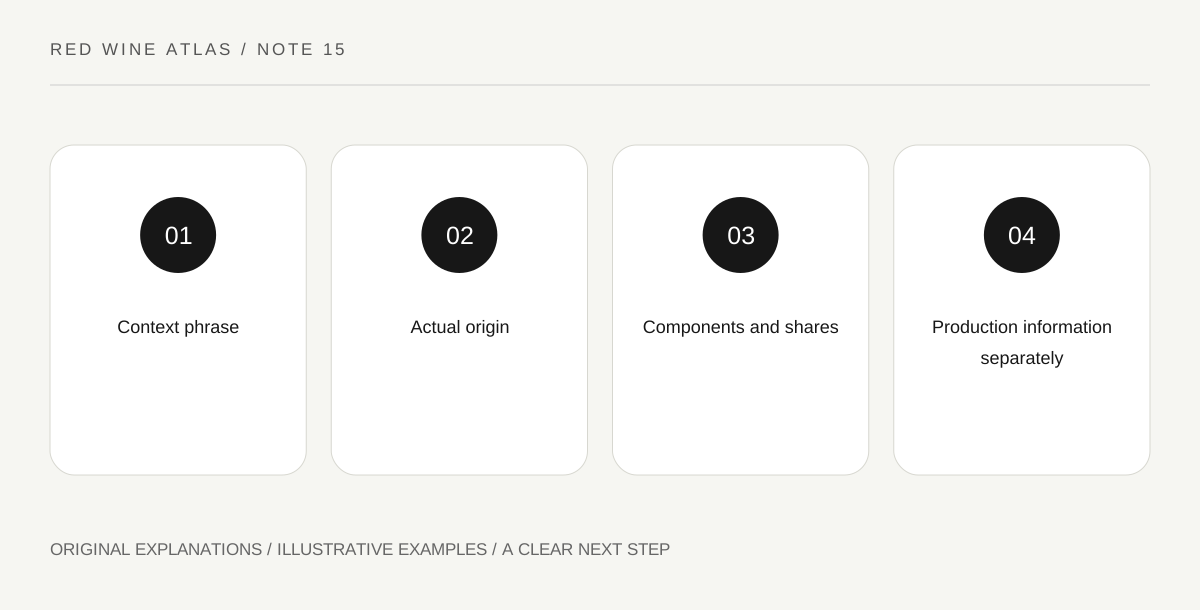
Original explanatory diagram. Read the full method and limitations below.
A family of compositions
Bordeaux’s blending explanation discusses Merlot, Cabernet Sauvignon and Cabernet Franc among the red-wine components. Its account emphasizes decisions about combining components rather than a single unchanging formula. Treat Bordeaux-style as a contextual expression when used outside the region, and look separately for an actual origin claim. A stylistic comparison does not move grapes geographically. On a worksheet, put the phrase in a style-context field, list grapes in composition fields and preserve origin wording independently. This keeps three types of statement visible even when promotional prose folds them into one short sentence.
Read a complete composition as a whole
Suppose a fictional technical sheet gives 60% Merlot, 25% Cabernet Sauvignon and 15% Cabernet Franc. The shares sum to 100%, so they can support a complete pie chart for that fictional blend. If another sheet lists only Merlot and Cabernet Sauvignon without figures, it supports a component list, not the same pie chart. Do not reuse percentages because the style phrase looks similar. Arithmetic should follow the actual statement. Also keep the year or specific bottling attached to a composition: a producer’s information about one release does not automatically describe every release under a similar name.
Separate blending from maturation
The Bordeaux source describes options to combine components at different stages and to mature them in different vessels. The reading lesson is that knowing the final grape shares does not disclose the entire production sequence. A blend may be described quantitatively without specifying how each component was treated. Draw composition and production as parallel tracks rather than one interchangeable set of facts. Your composition chart can be complete while the production timeline remains partly blank. That is not a contradiction. It accurately reflects two questions with different levels of documentary support.
Check the scope of a percentage
Percentages can describe planted vineyard area, harvested fruit or the finished blend. These are not automatically the same denominator. Before drawing a chart, write a short title naming what the numbers represent. A figure headed vineyard plantings should not become a chart titled composition of this wine. The error can survive perfectly correct addition because it concerns meaning rather than arithmetic. In an educational example, annotate every percentage with its subject. Only then compare values. This habit also makes it easier to spot when a general regional overview has been mistaken for a producer’s specific composition statement.
Before calculating, read the chart title aloud. If the title changes the subject of the numbers, revise it first.
Illustrative study exercise
Card A describes vineyard plantings as 70% grape X and 30% grape Y. Card B gives a fictional finished blend of 55% X and 45% Y. Both totals equal 100%, but their subjects differ. Make two charts with explicit titles. Copying A’s numbers onto B would be a denominator error, not an alternative interpretation of the same composition.
Practical checks
Optional checkboxes save only in this browser.
Questions that come up
Does Bordeaux-style prove Bordeaux origin?
No. Read the actual origin statement. A comparison with a blending tradition and a geographical claim are separate information.
Do grape shares reveal the entire cellar process?
No. Composition and production sequence are different questions. One can be documented more fully than the other.
References and scope
These sources support the factual background. Examples and exercises are original illustrative teaching material. References do not imply endorsement.
- Bordeaux: blending — Red Bordeaux components, blending choices and varied maturation vessels.