Syrah and Shiraz: two names, varied styles
Syrah and Shiraz name the same grape, but a name alone cannot divide all examples into two guaranteed styles. Wine Australia’s overview shows variation across regions and winemaking choices. Identify the grape first, then read the rest of the description.
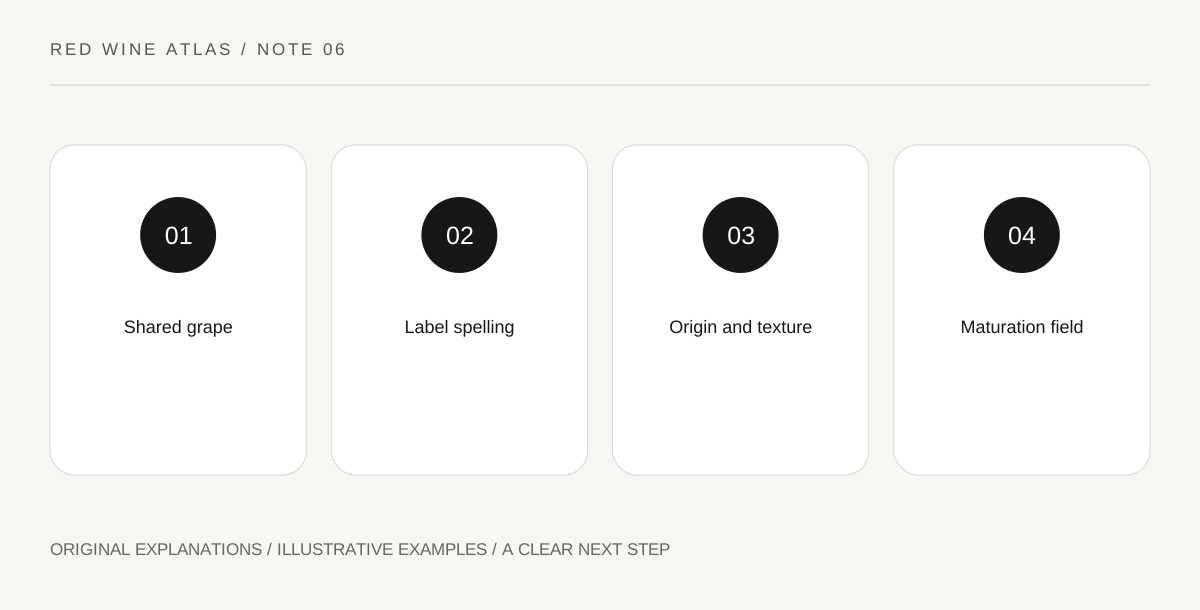
Original explanatory diagram. Read the full method and limitations below.
Resolve the name before predicting flavour
Wine Australia uses Shiraz and Syrah for the same variety. That establishes an identity connection without giving every wine an identical profile. Some descriptions use spelling to signal stylistic intention, but that is not a universal code. Create a normalized grape field reading Syrah/Shiraz and retain the exact label spelling separately. You can now recognize the common grape while preserving how each producer presented it. Neither field needs to erase the other. This approach is useful in a personal glossary because it links related entries without flattening their differences in origin, production and descriptive language.
Replace a binary with several questions
The shortcut Shiraz is rich while Syrah is restrained is too rigid to replace a full description. Ask about the stated region, texture, aroma language and maturation. Wine Australia describes varied expressions within Australian Shiraz, already challenging a simple two-box rule. On paper, place a hypothetical lighter Shiraz description beside a fuller Syrah description. You have not invented real products or disproved every broad tendency. You have shown why spelling alone is insufficient for a categorical prediction. A reader needs actual information about the example before deciding whether its description emphasizes weight, freshness or another feature.
Recognise a blend without inventing a grape
A Shiraz Cabernet blend supplies composition information beyond Shiraz alone. GSM is another context, involving Grenache, Shiraz and Mourvèdre. These phrases describe relationships among components; they do not create a new grape called GSM. Break a phrase into component names and leave proportions blank unless supplied. If the wording says only with Cabernet, preserve that wording rather than assuming which complete Cabernet name is intended. Precision helps more than filling gaps from habit. A component list can be meaningful even when it is not detailed enough to draw a proportional composition chart.
Read maturation independently
Wine Australia notes varied maturation approaches, including examples without oak. Oak is therefore not part of the definition of Shiraz. A note about older barrels, new barrels or another vessel adds production information without changing grape identity. Make a separate maturation row so that a grape question and vessel question remain distinguishable. If a description uses vanilla-like language but gives no maturation statement, record the comparison without treating it as proof of a particular barrel. The same separation applies to other aromatic clues: an association may prompt a question, but it cannot answer that question by itself.
When alphabetizing a glossary, create a cross-reference under both names. A reader searching either spelling should reach the shared identity entry without losing the label’s exact wording.
Illustrative reading exercise
Two fictional entries say Shiraz, Region X, no maturation detail supplied; and Syrah, Region Y, older-barrel maturation stated. Normalize both grape entries to Syrah/Shiraz. Retain original spelling and separate maturation fields. The difference in available information does not establish that every wine using one spelling follows the corresponding cellar approach.
Practical checks
Optional checkboxes save only in this browser.
Questions that come up
Are Syrah and Shiraz different grapes?
No. Wine Australia identifies them together. The names should not be treated as two unrelated varieties.
Can spelling tell me exact body?
No. A name may accompany an intended style, but region and winemaking vary. Use the specific description rather than a guaranteed spelling rule.
References and scope
These sources support the factual background. Examples and exercises are original illustrative teaching material. References do not imply endorsement.
- Wine Australia: Shiraz — Shiraz/Syrah naming, varied styles, GSM and varied maturation approaches.