Gamay is a grape; Nouveau is another question
Gamay often appears beside Beaujolais Nouveau, but these words answer different questions. A useful beginner’s exercise separates the grape, the geographical name and the particular production or release description, leaving room for more than one expression of the same variety.
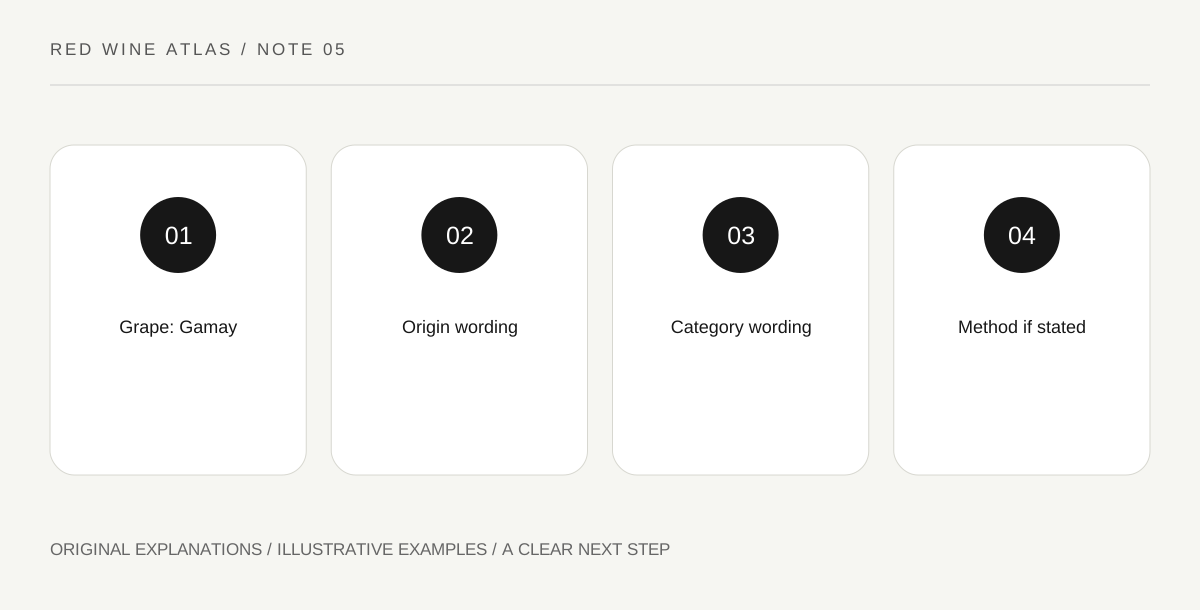
Original explanatory diagram. Read the full method and limitations below.
Start with three kinds of information
Gamay identifies a grape variety. Beaujolais supplies regional context, while Nouveau adds another category or release-related description in that context. Do not collapse this into Gamay means Nouveau. Inter Beaujolais’s explanation discusses Gamay and several vinification choices, including differences among the wines being made. Give each term its own field in a notebook. This helps when a description contains Gamay without Nouveau, or when a regional name appears more prominently than the grape. The absence of a familiar companion word is not an inconsistency. You are recording several related levels rather than memorizing one indivisible phrase.
Read the method paragraph before the adjective
A writer might call a wine fruity, youthful or fresh. Those adjectives can be informative, but they do not independently establish how it was made. Look for explicit process terms such as semi-carbonic maceration. Even then, do not invent a complete cellar procedure from one phrase. Highlight process claims in one colour and sensory claims in another. The exercise makes clear that fruity describes an impression, while a specified maceration method is a production statement requiring different support. A document can supply one without supplying the other; your notes should preserve that difference instead of bridging it with an assumption.
Avoid turning an introduction into a limit
A first encounter often becomes a mental rule: the first example was light, so this grape is always light. Replace that with a more precise memory: this description emphasized lightness. This helps when moving among regional categories and producers. Compare two written profiles with the same grape field and different texture phrases. You are learning the range of language applied to examples, not proving that every difference came from one variable. Vineyard conditions and production choices are not held constant in a casual comparison. A good learning note makes that limitation visible without losing the useful comparison.
Make a question tree for unfamiliar labels
When a Gamay-related label is unfamiliar, ask what it actually states, what the official regional source explains, and which details remain unspecified. Draw branches for grape, origin, category and method. There is no need to force every branch into a filled box. Method not stated on this label is a valid answer. This focuses learning on distinctions rather than unsupported fact collection. A later producer sheet may add a method statement without contradicting your original record, because the original record described the label’s information rather than claiming to explain every stage of the wine’s production.
As a final check, try reading the card aloud without its regional word. Notice how much context disappears even though the grape identity remains.
Illustrative reading exercise
Create fictional cards: A says Gamay, Region A, red wine; B says Beaujolais Nouveau, producer B. The first explicitly gives a grape; the second calls for regional-category context. Do not add Nouveau to A or a complete fermentation schedule to B. Each card supports a different amount of information, which your completed worksheet should show.
Practical checks
Optional checkboxes save only in this browser.
Questions that come up
Does Gamay always use one fermentation method?
No universal method follows from a grape name. The regional explanation describes choices; consult a specific producer statement for the particular wine.
Is Nouveau a grape variety?
No. Treat it as a separate term in the relevant wine description. Gamay is the grape name discussed here.
References and scope
These sources support the factual background. Examples and exercises are original illustrative teaching material. References do not imply endorsement.
- Inter Beaujolais: vinification — Gamay and the conceptual distinction between semi-carbonic and carbonic vinification.