Argentine Bonarda: identify the context before comparing names
An unfamiliar grape name can look like a gap that must be filled immediately. Argentine Bonarda offers a better lesson: start with the named regional context, learn what the source actually establishes and avoid equating similar names across countries without evidence.
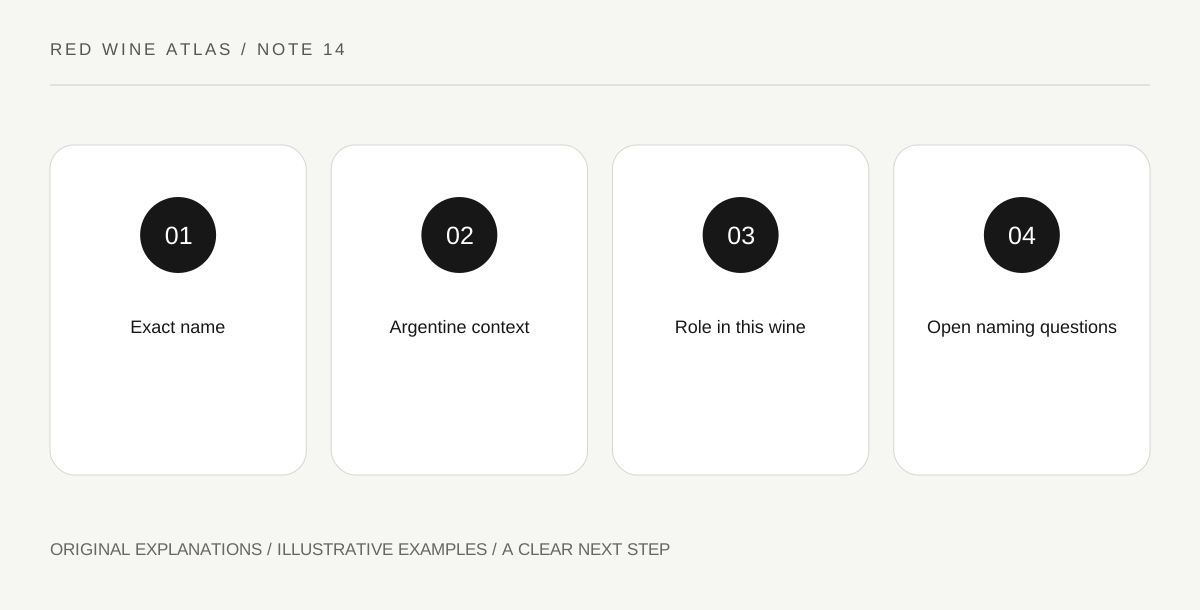
Original explanatory diagram. Read the full method and limitations below.
Begin with the Argentine reference
Wines of Argentina’s variety guide discusses Bonarda as an established red variety in the country, including its appearance in varietal wines and blends. Record this as an Argentine-context entry. That is useful information even before investigating every international naming relationship. A beginner’s glossary does not need to solve global grape nomenclature in its first sentence. It needs to avoid claiming more than it knows. Use a heading such as Bonarda in Argentine wine descriptions and preserve the exact source. This tells a future reader which context supported your explanation and which questions remain open.
Do not solve a naming problem by resemblance
A shared or similar grape word in another country deserves its own verification. Do not create an equivalence merely because the spelling matches. Conversely, do not invent a difference because the regions differ. A good index can hold two entries temporarily, linked by a question rather than an equals sign. This is a practical research technique, not an evasion: it keeps ambiguous information from spreading through a dataset of notes. If a later authoritative source establishes the relationship, add that evidence explicitly. Until then, the Argentine entry remains accurate within the context that was actually checked.
Read varietal and blend appearances separately
The guide discusses Bonarda in both varietal and blending contexts. These are different ways a grape can appear in a wine description. Imagine a card headed Bonarda and another reading red blend containing Bonarda. The second does not disclose its percentage merely by naming the component. A blend appearance also does not make the grape intrinsically inferior or incapable of another role. Keep composition and evaluation apart. If a technical sheet supplies complete percentages, use them; if it only lists components, show an unscaled set. The representation should match the information rather than implying that every named grape occupies an equal share.
Build an unfamiliar-grape study card
Use four fields: exact name, verified context, stated role and unresolved questions. Fill the first with the printed spelling, the second with Argentina, and the third with the role supplied by the particular document. A question about international synonyms belongs in the last field until verified. Then write one sentence explaining what the card permits you to say. For example, this source discusses Bonarda in Argentine red wine and gives no complete composition for this example. The exercise replaces a vague feeling of unfamiliarity with a bounded set of useful facts, without pretending to have completed an ampelographic investigation.
Put the unresolved synonym question in a separate margin rather than inside the grape’s definition.
Illustrative study exercise
A fictional sheet says Argentine red blend, Malbec and Bonarda, percentages not supplied. Create two component cards and one blend card. Link both components to the blend without sizing the links. A similar-looking name on an unrelated foreign label remains a separate research question. Neither the shared word nor its unfamiliarity licenses an automatic equivalence.
Practical checks
Optional checkboxes save only in this browser.
Questions that come up
Can a grape appear both alone and in blends?
Yes. The guide discusses different uses of Bonarda. Its role in one composition does not define its only possible role.
Should I guess an unfamiliar name from spelling?
No. Preserve the exact wording and verify its context. A clear unresolved question is more useful than a confident but unsupported equivalence.
References and scope
These sources support the factual background. Examples and exercises are original illustrative teaching material. References do not imply endorsement.
- Wines of Argentina: varieties — Malbec’s national association and regional variation; Argentine Bonarda in varietal and blend contexts.